BRTA Tops Corruption List in Bangladesh BBS Citizen Survey 2026


 January 7, 2026 11:19 pm
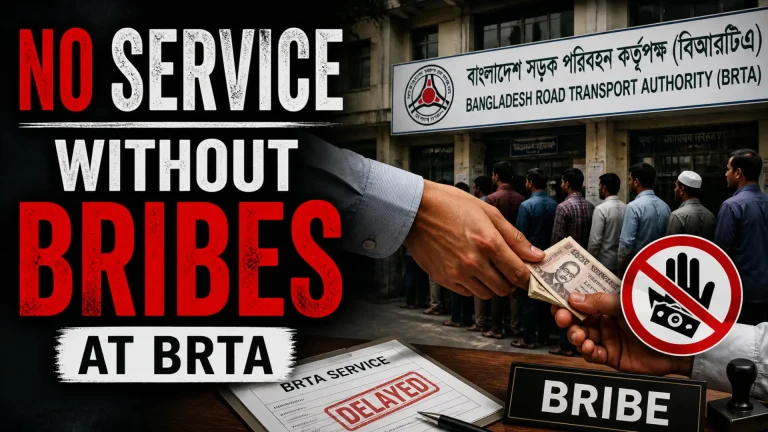
BRTA Tops Corruption List in Bangladesh. The Bangladesh Road Transport Authority (BRTA) has been identified as the most corruption-prone government office in the country, according to the Citizen Perception Survey (CPS) 2026 released by the Bangladesh Bureau of Statistics (BBS).
BRTA Leads in Bribery Cases
The CPS 2026 reveals that 63.29% of citizens who sought services from BRTA reported experiencing corruption. This makes BRTA the top-ranking public service office for bribery in Bangladesh.
Following BRTA, law enforcement agencies reported a 57.96% bribery rate, while passport offices were next at 57.45%, highlighting persistent corruption in key citizen-facing services.
Bribery Patterns Across Government Services
The survey showed that 31.67% of respondents admitted paying bribes directly while receiving government services in the past 12 months.
- Men were more likely to pay bribes (38.62%) than women (22.71%).
- Almost all bribes (98.48%) were paid in cash.
Other government offices ranked by bribery incidence include:
| Government Office | Bribery Rate (%) |
|---|---|
| Land Registry / Cadastre | 54.92 |
| Judges, Magistrates & Prosecutors | 53.77 |
| Land Record, Acquisition & Settlement | 51.40 |
| Accounts Offices | 44.68 |
| Customs, Excise & VAT Offices | 35.37 |
| Local Government (Union, Pourashava, Upazila) | 32.91 |
| Election Offices (District/Upazila) | 26.04 |
| Social Security & Welfare | 19.20 |
| Public Utilities (Electricity, Gas, Water) | 18.41 |
| Elected Local Representatives | 14.94 |
| Income Tax / Revenue Offices | 14.08 |
| District & Upazila Administration | 11.33 |
| Agricultural Offices | 9.07 |
| Public Healthcare (Doctors, Nurses) | 8.05 |
| Members of Parliament | 7.91 |
| Anti-Corruption Commission | 1.99 |
| Government & Autonomous Banks / Insurance | 2.98 |
| Public Educational Institutions | 2.94 |
These findings indicate that transport, law enforcement, and land-related services remain highly vulnerable to corruption, despite ongoing reform efforts.

Survey Methodology
The BBS conducted the CPS nationwide from February 6–23, 2025, covering 64 districts.
- Respondents: 84,807 individuals aged 18 and above
- Gender Breakdown: 39,894 men and 44,913 women
- Households Surveyed: 45,888
- Primary Sampling Units (PSUs): 1,920
The survey also assessed six SDG 16 indicators, including security, governance, public service quality, corruption, access to justice, and discrimination.

Citizens Perception of Safety and Governance
Safety and Security
- 84.81% felt safe walking alone after sunset.
- Men reported higher safety (89.53%) than women (80.67%).
- Safety at home after dark was 92.54%.
Governance and Political Participation
- Only 27.24% believed they could influence government decisions.
- Regarding political decision-making, this dropped to 21.99%.
- Around 24.62% felt that the political system is inclusive and responsive, with minimal rural-urban difference.
Access to Public Services
Over the past year, citizens reported accessing various government services:
- Healthcare: 47.12%
- Primary or Secondary Education: 40.93% (at least one child)
- Other Services: 73.77% (ID cards, civil registration, etc.)
Satisfaction levels varied by service type:
- Healthcare: 72.69%
- Primary education: 81.56%
- Secondary education: 78.18%
- Other government services: 66.91%
Dispute Resolution and Discrimination
- 16.16% experienced disputes or conflicts in the past two years.
- Of these, 83.60% accessed some form of resolution:
- Formal institutions: 41.34%
- Informal mechanisms (community leaders): 68.96%
Discrimination
- 19.31% reported discrimination.
- Common reasons: socio-economic status (6.82%) and gender (4.47%).
- Incidents occurred mainly:
- Within families: 49.72%
- Public transport/open spaces: 34.82%
- Workplaces: 24.85%
- Only 5.37% reported discrimination to authorities.
Conclusion
The BBS Citizen Perception Survey 2026 confirms that BRTA tops corruption lists among public service offices in Bangladesh. Corruption persists across many citizen-facing services, emphasizing the importance of reforms, accountability, and better governance.